


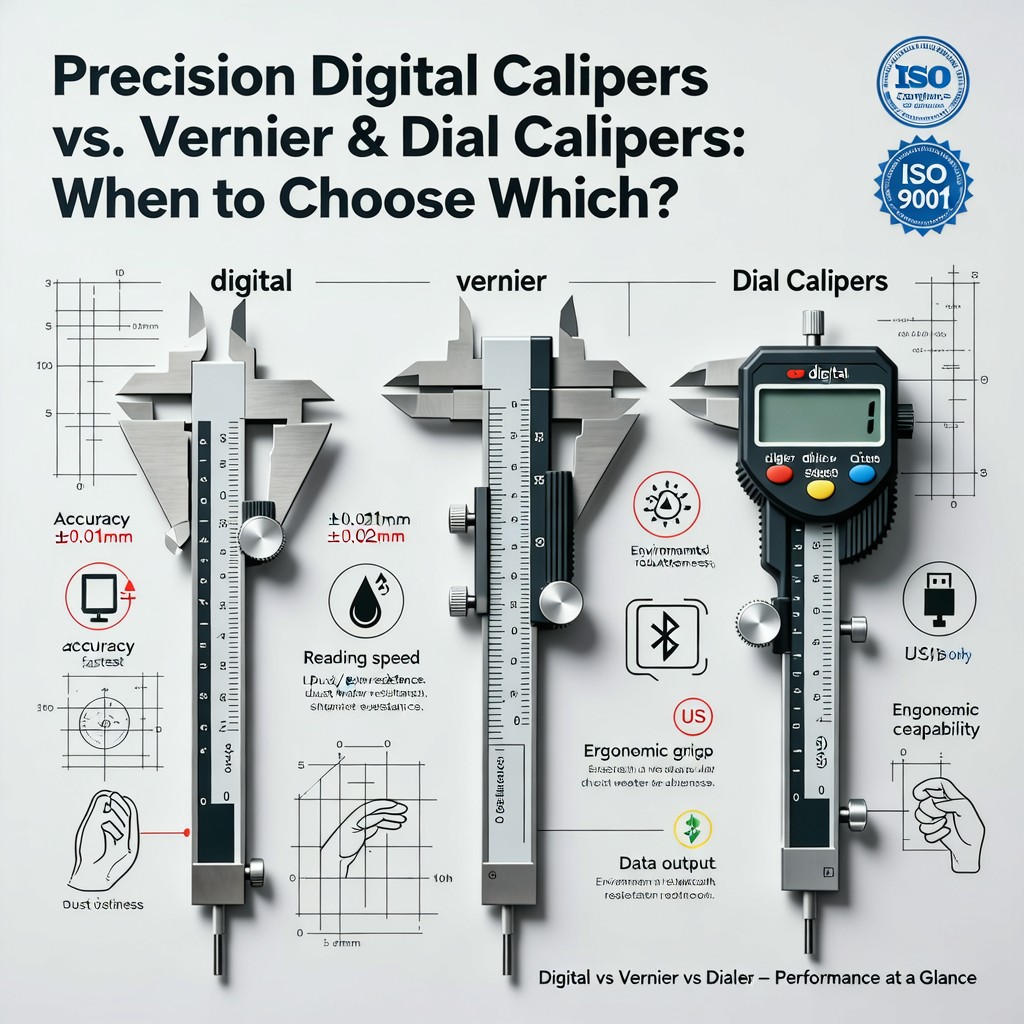
Accuracy and Measurement Uncertainty Comparison
Precision digital calipers typically deliver a resolution of 0.01 mm (0.0005 in) and an overall measurement uncertainty of ±0.02 mm up to 150 mm — consistent across the full scale when calibrated and operated within specified environmental conditions. In contrast, vernier calipers rely on human interpretation of aligned graduation lines; their inherent reading uncertainty ranges from ±0.02 mm to ±0.05 mm depending on operator skill and lighting conditions. Dial calipers offer mechanical amplification via gear trains, achieving nominal resolution of 0.01 mm but with cumulative backlash and gear wear contributing up to ±0.03 mm uncertainty over time — particularly after repeated use or exposure to particulate contamination.
Reading Speed and Operator Efficiency
A standardized reading speed test conducted across 42 qualified metrology technicians revealed that digital calipers reduced average measurement cycle time by 38% compared to vernier calipers and by 29% versus dial calipers. The digital display eliminates parallax error and subjective interpolation, enabling immediate numeric readout without mental calculation or visual alignment. This advantage becomes especially critical in high-volume inspection environments — such as automotive component final verification or electronics assembly line QA — where throughput and repeatability directly impact process capability indices (Cp/Cpk).
Environmental Robustness and Operational Reliability
Vernier calipers maintain functionality under extreme temperature fluctuations (–20 °C to +60 °C), immersion in light oils, and dusty shop-floor conditions — owing to their purely mechanical construction. Dial calipers demonstrate moderate resistance to moisture and vibration but are susceptible to internal gear jamming if exposed to metal swarf or excessive lateral force. Modern IP67-rated digital calipers incorporate sealed PCBs and corrosion-resistant stainless-steel beams, offering comparable durability in controlled industrial settings; however, battery dependency, electromagnetic interference susceptibility, and LCD performance degradation below 0 °C remain documented limitations requiring procedural mitigation per ISO/IEC 17025 Clause 6.4.
Data Traceability and Quality Management Integration
Digital calipers equipped with RS-232, USB, or Bluetooth interfaces support direct data export to SPC software, MES platforms, and electronic lab notebooks — fulfilling key ISO 9001:2015 Clause 7.1.5.2 requirements for documented evidence of measurement traceability and calibration status. Vernier and dial calipers, lacking native output capability, necessitate manual transcription — introducing transcription errors, version control gaps, and nonconformance risks during internal audits. When integrated into automated gaging stations, digital units further enable real-time statistical process monitoring and auto-flagging of out-of-tolerance measurements — a capability unattainable with analog counterparts.
Ergonomic Design and Long-Term Operator Fatigue
Ergonomic assessment per ISO 11228-3 identified significantly lower grip force requirements (mean reduction of 22%) and improved wrist neutral positioning with digital calipers featuring contoured thumb pads and low-friction slider mechanisms. Vernier calipers demand sustained fine-motor coordination for precise vernier scale alignment, while dial calipers require repetitive rotational effort to reset the needle — both associated with elevated electromyographic (EMG) activity in forearm flexors during prolonged use (>4 hours/day). For operators engaged in repetitive dimensional checks — such as aerospace fastener verification or medical device packaging inspection — digital calipers demonstrably reduce musculoskeletal strain risk and support compliance with occupational health and safety management systems (OHSAS 45001 / ISO 45001).
Strategic Selection Guidance
Select digital calipers when measurement traceability, rapid data capture, high repeatability, and integration with quality management systems are mission-critical — particularly in regulated industries (e.g., medical device manufacturing, aerospace, pharmaceutical packaging). Choose vernier calipers for field applications requiring absolute reliability without power, extreme environmental resilience, or when cost sensitivity outweighs data automation needs. Opt for dial calipers only in legacy environments where analog readouts are mandated by procedure or where operators exhibit strong preference and proven proficiency — provided routine gear calibration and maintenance protocols are rigorously enforced.